It’s hilarious when you actually think “when was the last time you didn’t optimize?”. Last time you just sat there like “nah” just let prefer the long way.
If you’ve been knee-deep in clients and agents like me. FastMCP (just dropped its 3.0 release, it’s got me overwhelmed. Kind of like Composio. Gone are the days of bolted-on features and ad-hoc hacks from version 2. Instead, we’re looking at a sleek, composable system that’s designed to scale with your wildest ambitions.
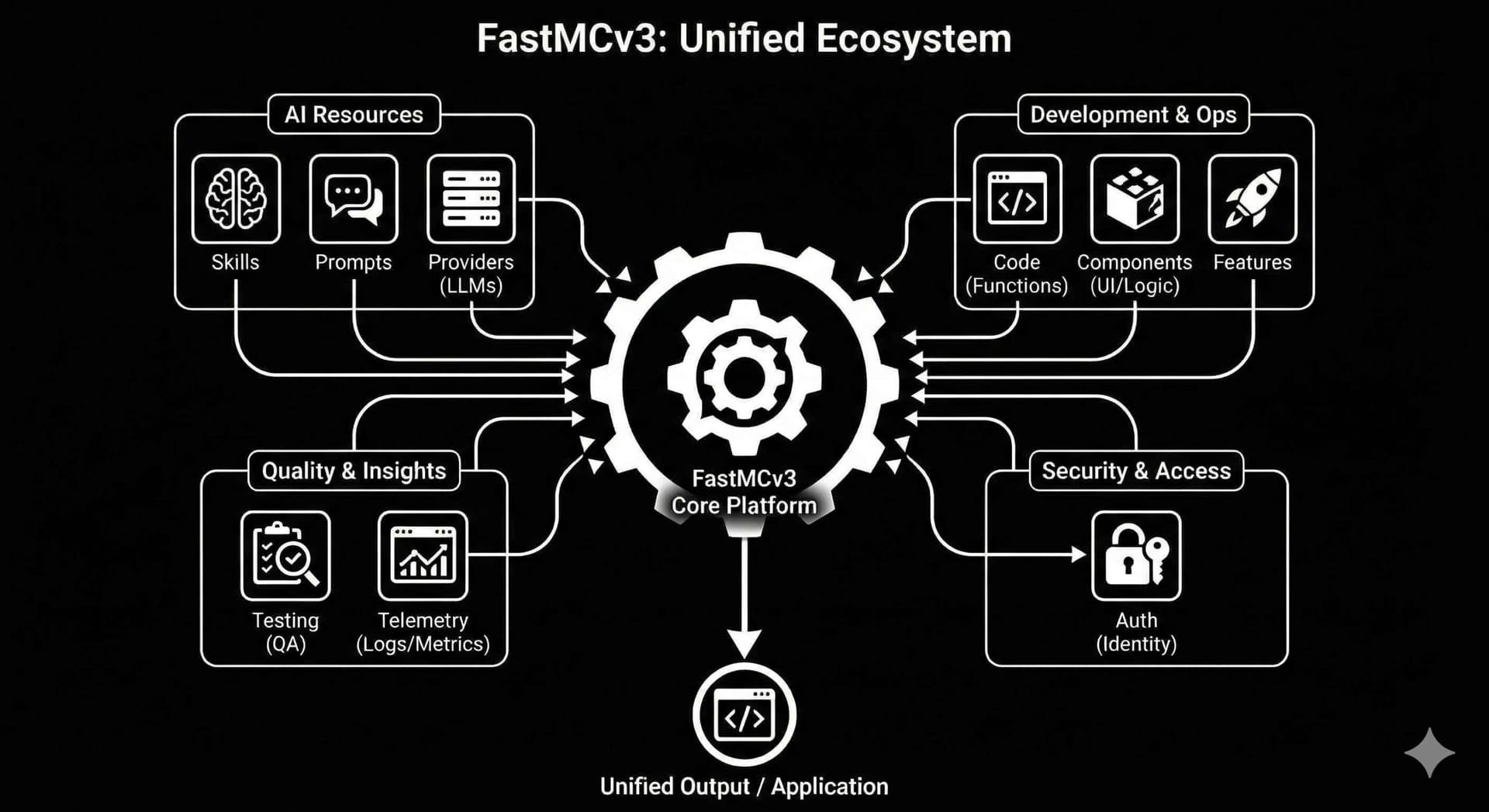
FastMCP is now organized around three core abstractions:
- Components
- Providers
- Transforms
That’s the framework.
EVERYTHING else — skills, tools, prompts, your sister, APIs — sits inside that structure.
Components
Components are what the model interacts with.
There are three kinds:
- Tools (callable actions)
- Resources (retrievable context or data)
- Prompts (structured instructions or templates)
This is where skills live.
A skill is not a separate concept. It’s a prompt, a resource, or a bundle of both. Treated the same way. Loaded the same way. Governed the same way.
Calling them “skills” is a packaging decision, not an architectural one.
Providers
Providers answer one question: where do components come from?
A provider can load components from:
- local Python cod
- a filesystem directory (skills, prompts, references)
- an OpenAPI specification
- a remote MCP server
This makes sourcing explicit. Nothing is magical. A FastMCP server is just a provider that speaks MCP.
Transforms
Transforms control how components appear once they’re loaded.
They handle:
- namespacing
- filtering
- visibility
- versioning
- authorization
- per-session gating
This is where governance lives.
Instead of baking behavior into mounts, flags, or ad-hoc logic, FastMCP applies transformations to a set of components. Composition replaces glue code.
Key New Features: What’s Actually Game-Changing
Let’s unpack the features with a bit more depth. I’ve pulled these straight from the official docs and release notes, focusing on what they’ll mean for your day-to-day.
- Composable Primitives (The Core Rewrite)
Everything stems from Components + Providers + Transforms. This isn’t just buzz—it’s a fundamental architecture change. In v2, features felt tacked on; now, they’re emergent. For example, mounting another server? That’s now a Provider (source) + Transform (namespace it properly). Dead simple, infinitely extensible. - Per-Component Authorization
Security got a massive glow-up. Attach auth checks directly to tools, prompts, or resources (e.g.,@tool(auth=my_auth_handler)). Or use server-wide middleware for blanket rules. This granularity means you can expose public tools alongside internal ones without spinning up separate instances. OAuth, JWT, API keys—plug in whatever fits. - Resources and Prompts as Tools
Auto-wrapping magic: Turn any resource or prompt into a full-fledged tool with proper arg/response mapping. This slashes boilerplate and boosts interoperability. Imagine feeding a database query (resource) directly into an LLM prompt (as a tool)—seamless. - Extensible Transforms
SubclassTransformto create custom logic: filtering by user role, auto-tagging for discoverability, shaping namespaces dynamically. It’s like middleware but for your entire component graph. Power users will love this for building domain-specific behaviors. - Universal Context Composition
Source components from anywhere: Python decorators, local dirs, OpenAPI endpoints, remote MCPs, or bespoke providers. Mix ’em all in one server. This makes hybrid setups (e.g., local dev tools + cloud resources) trivial. - Long Operations & Background Tasks
No more blocking your agent sessions on heavy lifts. Kick off async work in the background—perfect for data processing, model inference, or API calls that take time. Agents stay responsive; your users stay happy. - Versioned Components
Serve multiple versions side-by-side (@tool(version="1.2.3")). Clients default to the highest stable one, but you can override via transforms. Ditch custom versioning libs; this built-in handles deprecation, rollouts, and A/B testing elegantly. - Improved Developer Experience (DX)
Hot reload on file changes viafastmcp devmode. Decorators now return plain Python callables—no more opaque wrappers. It’s the little things that make debugging less of a nightmare. - Automatic Threadpool for Sync Code
Synchronous tools? They auto-dispatch to a thread pool, keeping your event loop free. Say goodbye to manual async wrappers or threading hacks. - Enterprise-Grade Observability
Native OpenTelemetry integration for traces, metrics, and logs. Standardized attributes mean less bespoke instrumentation—plug into tools like Prometheus or Jaeger out of the box. - API Versioning & Governance
Built-in policies and transforms to enforce versions. Gate access based on client headers or sessions—great for evolving APIs without breaking clients. - Full Session State Tracking
Track and evolve context per session. This powers dynamic playbooks, stepwise reveals, or adaptive agents that “remember” mid-conversation. - Mounting as First-Class Composition
Old mounts? Obsolete. Now it’s all providers + transforms, making composition a core strength rather than a special case.
These aren’t just checkboxes—they cotelligence.
What v2 Users Actually Need to Change
Most migrations are deletions.
- Replace mounts with provider + transform composition.
- Move global auth to per-component rules.
- Remove custom version routing.
- Drop manual thread handling for sync tools.
- Replace ad-hoc session hacks with the session state API
Tests may need adjustment because decorated functions now remain normal Python functions.
That’s it.
The Important Clarification
FastMCP 3 doesn’t invent the wheel. It just standardizes the cars – Capability exposure and governance so those problems stop being solved badly over and over.
Skills are treated the same as prompts and resources because they are the same thing structurally.
Three abstractions. Clean boundaries. No magic.
Why This Matters: A Vision for AI’s Future
As agents get smarter, they need ecosystems that adapt without friction. This release positions MCP as a foundational layer for that—scalable, secure, and inspiringly flexible.
Test thoroughly—focus on auth flows, long tasks, and composition. Orsit and stare as you’re paralysed by what choices like me.
If you’re on v2, upgrade soon; the wins compound over time. For new folks, start here—it’s the consolidated env you’ve always wanted.